
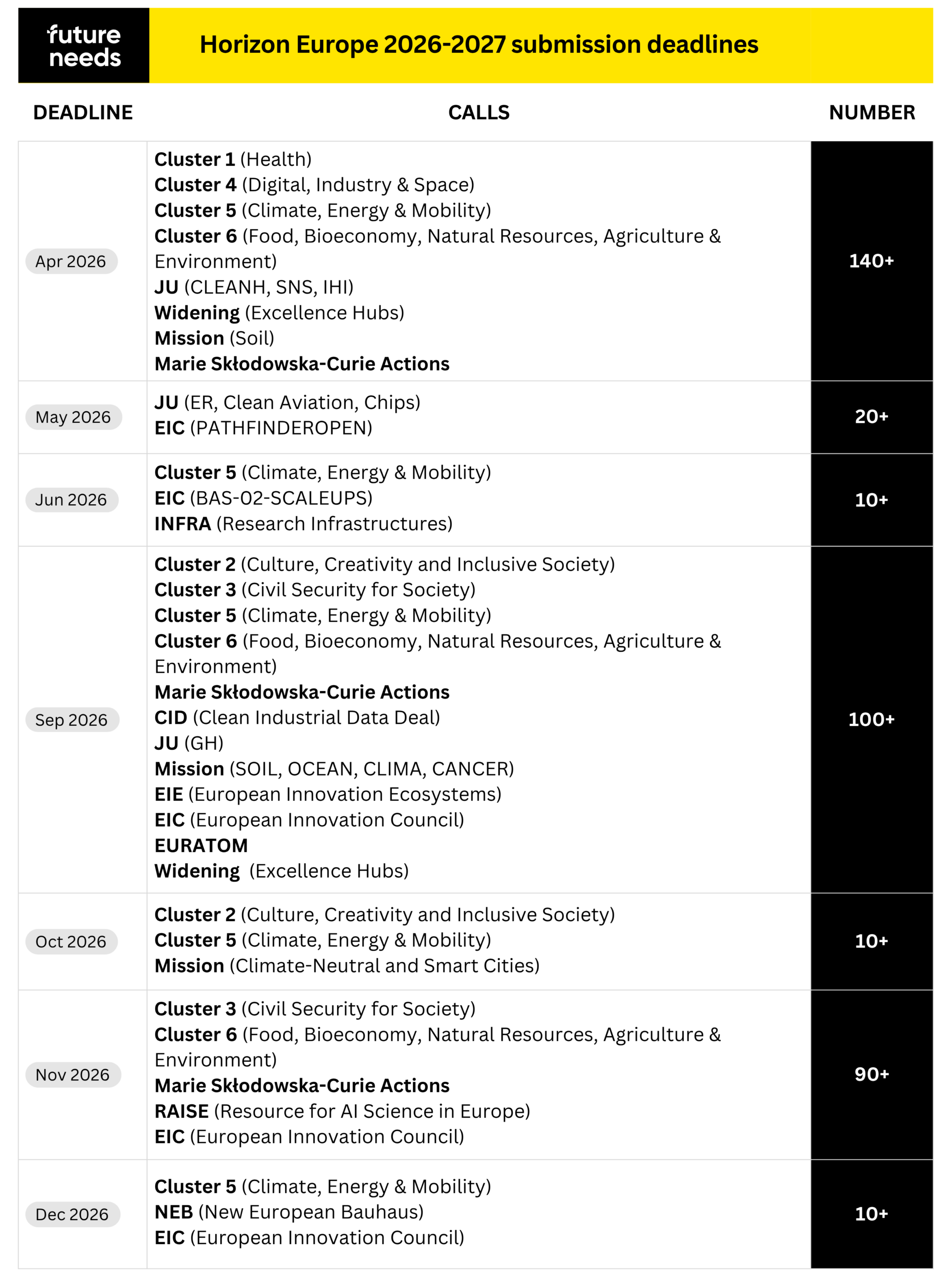
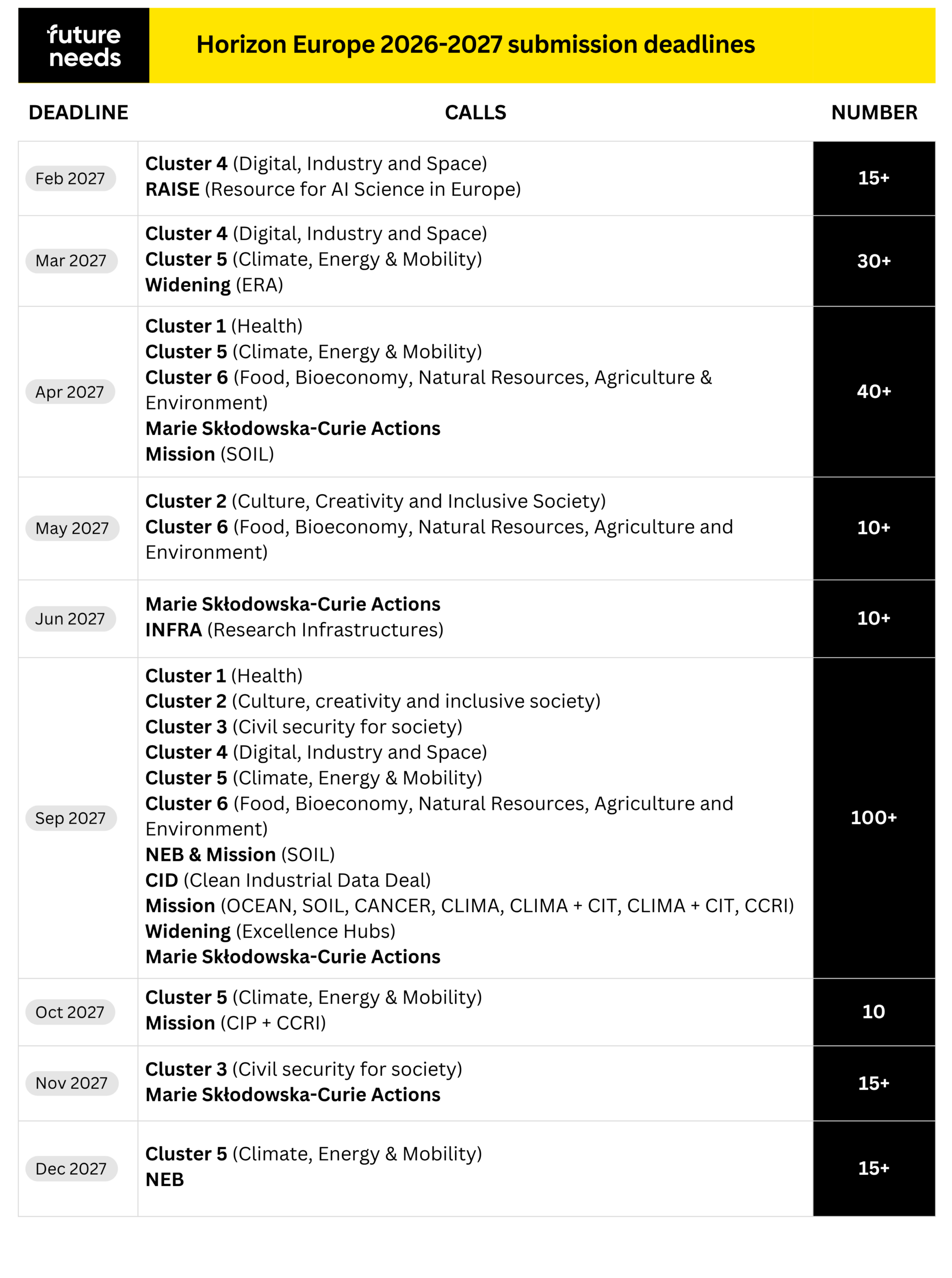
With the publication of the Horizon Europe Work Programme 2026–2027 (HaDEA), attention across the research and innovation community has predictably shifted to submission deadlines. The calendar quickly fills: major calls cluster in April and September, with additional opportunities appearing in February and October, depending on the cluster and instrument.
On paper, this creates a reassuring picture. Deadlines are visible, spread across the year, and seemingly manageable. Many teams respond accordingly by counting backwards from the submission date and planning their writing effort around it.
In practice, this is where many Horizon Europe proposals begin to lose ground. Deadlines are not the moment when proposal quality is shaped. They are the moment when earlier decisions about ambition, partnerships, scope, and internal alignment become visible. By the time a deadline feels “close,” the factors that determine competitiveness are often already fixed, for better or worse.
For experienced applicants, this is not new. Competitive proposals are rarely written under deadline pressure alone. They are built through a longer process that starts months earlier, well before writing begins.
The real proposal timeline: what happens before writing starts
Across clusters and instruments, the preparation of a Horizon Europe proposal follows a recurring pattern. While details vary by topic and consortium, the underlying journey remains remarkably consistent, particularly for collaborative projects with September deadlines.
What follows is not an idealised process, but a realistic one, reflecting how most consortia actually move from a published Work Programme to a submitted proposal.
Phase 1: Early signals and positioning
(around 8–6 months before the deadline or earlier)
This phase begins quietly.
The Work Programme is published, or pre-published drafts begin circulating. Calls are not yet open, and writing feels premature. Many teams describe this period as “too early to start,” even though important groundwork is already taking place.
Typical activities in this phase include:
- Monitoring the Work Programme and related updates
- Scanning topics for relevance and strategic fit
- Initial internal discussions about whether a call is worth pursuing
- Core partnership is formed
At this stage, uncertainty dominates. Topic texts are read cautiously. Teams are curious, but non-committal. Decisions are provisional, and few partners are ready to invest serious time.
Yet this is where positioning begins. Early interpretation of the topic, even if incomplete, influences which ideas are explored and which are discarded. Waiting passively during this phase often means inheriting decisions later — shaped by others who moved sooner.
Phase 2: Info days and interpretation
(around 6 months before the deadline)
As infodays take place — online and in person — the picture starts to sharpen.
Infodays rarely provide definitive answers, but they do offer valuable signals: clarifications of scope, emphasis points, and implicit expectations behind the topic text. For attentive teams, this phase is less about “finding the answer” and more about refining interpretation.
Typical activities include:
- Attending infodays and information sessions
- Comparing interpretations across partners
- Testing early ideas against Work Programme priorities
This is when first concept writing occurs. It is a thinking phase. The goal is to reduce ambiguity enough to decide whether a concept is viable and worth committing to.
Teams that skip this step often move directly into drafting later, only to discover misalignment between their idea and the evaluator’s expectations.
Phase 3: Consortium formation and commitment
(around 6–5 months before the deadline)
This is where preparation becomes real.
Around late spring — April, for many September calls — discussions shift from exploration to commitment. Consortia begin to take shape. Partners outside the core team are approached, roles are negotiated, and responsibilities are tentatively assigned.
Typical focus areas include:
- Identifying complementary expertise
- Securing partners with credible roles, not just names
- Aligning expectations on contribution and workload
- Adding partners to the proposal in the funding and tenders portal
This phase is decisive. The composition and internal logic of the consortium will shape the proposal’s ambition, feasibility, and coherence long before a single paragraph is written.
Once partnerships are finalised, flexibility decreases. Late changes are costly, and unresolved uncertainties tend to resurface later, often during budgeting or final drafting, when there is little time to correct course.
At this point in the process, many teams still feel they have “not started yet.” In reality, the foundations of the proposal are already being laid.
Phase 4: From ideas to structure
(around 5 months before the deadline)
Once a consortium is largely in place, the focus shifts from whether to apply to what exactly will be proposed.
This is the phase where high-level ideas are tested against the realities of the Work Programme. Broad ambitions need to be translated into a coherent extended concept that fits the scope, expected outcomes, and constraints of the call.
Typical activities in this phase include:
- Turning early ideas into a structured project concept and preliminary Work Package structure
- Mapping objectives and expected outcomes against the topic text
- Identifying the core logic of the proposal: why this consortium, why now, why this approach
This work often happens through an extended concept note, slide decks, or internal summaries rather than formal proposal text. The aim is not polish, but alignment.
Decisions taken here quietly shape the rest of the process. An overly ambitious concept may survive initial discussions, only to collapse later under budget or feasibility pressure. A vague concept may move forward, but struggles to convince evaluators once details are required.
Teams that invest time in this phase gain clarity early. Those who rush it often carry unresolved questions forward, where they become harder to address.
Phase 5: Draft logic and task structure emerge
(around 3–2 months before the deadline)
As the deadline approaches, abstract ideas begin to solidify into something recognisable as a proposal.
By this stage, many consortia aim to have:
- A short ambition or motivation document outlining the project’s core narrative
- A more mature Work Package and task structure
- A first draft of the Impact section
- Initial thoughts on who does what and budget — even if imperfect
This is often a messy phase. Task descriptions overlap. Responsibilities are uneven. Gaps appear between ambition and implementation. It is not unusual for this material to feel fragmented or inconsistent.
What matters is not that everything is perfect, but that the underlying logic is visible and can be tested.
This phase acts as a stress test. Weaknesses that were abstract earlier now become concrete:
- Is the workload realistic?
- Are partner roles credible and balanced?
- Does the structure actually deliver the promised outcomes?
If these questions are addressed here, the proposal gains stability. If they are postponed, they tend to resurface later — when time and flexibility are limited.
Phase 6: Budget pressure and the “valley of death”
(around 1 month before submission)
For many consortia, this is the most difficult phase of the entire process.
As budgets are drafted and aligned with tasks, unresolved issues come to the surface. Contributions that seemed reasonable in theory may no longer fit. Partners reassess their level of engagement. Motivation can dip, particularly for proposals targeting September deadlines after a long preparation period.
This stage is often described as a turning point:
- Engagement becomes uneven
- Momentum slows
- Some teams quietly step back (especially during summer)
It is here that a significant number of proposals lose viability, not because the idea is weak, but because the process has exhausted the consortium’s capacity to push forward.
Experience shows that consortia with: a) clearly defined authorship, and b) structured support through this phase are far more likely to continue. Others struggle to recover, even with substantial effort in the final weeks.
By the time this phase is reached, the deadline is close, but the room for strategic correction is already narrow.
What follows is the most visible part of the process: the final rush to submission. But by then, leverage is limited, and most outcomes are already determined.
Phase 7: The final stretch
(last 15 days before the deadline)
The final weeks before submission are intense, visible, and familiar to anyone who has worked on a Horizon Europe proposal.
At this point, most structural decisions have already been made. The focus shifts to execution:
- Finalising text across all sections
- Completing Gantt charts, tables, and forms
- Consolidating partner inputs
- Addressing ethics, open science, and formal requirements
- Collecting declarations and letters of support
Activity levels peak, but strategic flexibility is minimal. Changes made at this stage are often reactive, fixing inconsistencies, filling gaps, or reconciling last-minute partner feedback. While effort is high, leverage is low. The quality of the proposal in these final days largely reflects the groundwork laid months earlier. Strong structures tend to hold. Weak ones require disproportionate energy from the proposal coordination team to stabilise.
For many teams, this phase is less about improvement and more about endurance.
Phase 8: Submission
(deadline day)
Submission marks the end of a long process.
Proposals are uploaded, sometimes well ahead of time, sometimes just before the system closes. Relief follows exhaustion. For a brief moment, attention shifts away from what could still be changed to what has already been delivered.
Not all proposals reach this point. Despite months of preparation, some consortia fail to submit any version at all. Others submit proposals they know could have been stronger, had key decisions been taken earlier.
In both cases, the outcome rarely hinges on the final days alone.
Reframing the question: when does Horizon Europe preparation really start?
The publication of the Horizon Europe Work Programme 2026–2027 provides clarity on topics, budgets, and timelines. It also triggers a familiar reaction: a renewed focus on deadlines.
Deadlines matter. But they are signals, not starting points.
Competitive Horizon Europe proposals are shaped long before writing begins, during months of interpretation, alignment, and decision-making that remain largely invisible in the submission calendar. Early preparation creates space to think, not just to act. It allows consortia to test ideas, build credible partnerships, and resolve tensions before they become risks.
Experienced teams recognise this. They treat proposal development as a process, not an event, and engage support when it can still influence structure, not only when pressure is highest.
For the 2026–2027 calls, the most important question is not when the deadline is. It is when should preparation begin?
That answer almost always comes earlier than expected.
What this means for your 2026–2027 proposal planning
For Horizon Europe 2026–2027, the Work Programme is already published, and the submission calendar is visible. What remains less visible — but far more decisive — is the preparation window that comes before drafting begins. This early phase is where topic interpretation is tested, consortia are shaped, and proposal logic is built. Once deadlines feel close, the opportunity to influence these elements has largely passed.
Future Needs supports consortia during this upstream phase — before writing pressure sets in — helping teams structure ideas, align partners, and build proposals that are coherent, credible, and ready for evaluation.
If you are considering a 2026 or 2027 Horizon Europe call, the most effective moment to start the conversation is not when the deadline approaches, but when the preparation window opens. Let’s talk – email us at info@futureneeds.eu.
