
The ERC Funding scheme has changed over the years, and in the 2026 ERC Work Programme, the ERC Plus Grant has been introduced. In short, the ERC Plus Grant is a new funding scheme evolving from the ERC Programme, designed to go beyond the scope of traditional ERC grants. It’s not replacing existing schemes (Starting, Consolidator, Advanced, Synergy), but rather sitting above them as a highly selective, high-impact funding instrument.
Let’s dive into the ERC Plus Grant to understand who this is for and how it works!
What is the ERC Plus Grant?
The ERC Plus Grant is designed to support exceptional researchers with bold, visionary ideas that go beyond the scope of traditional ERC funding schemes.
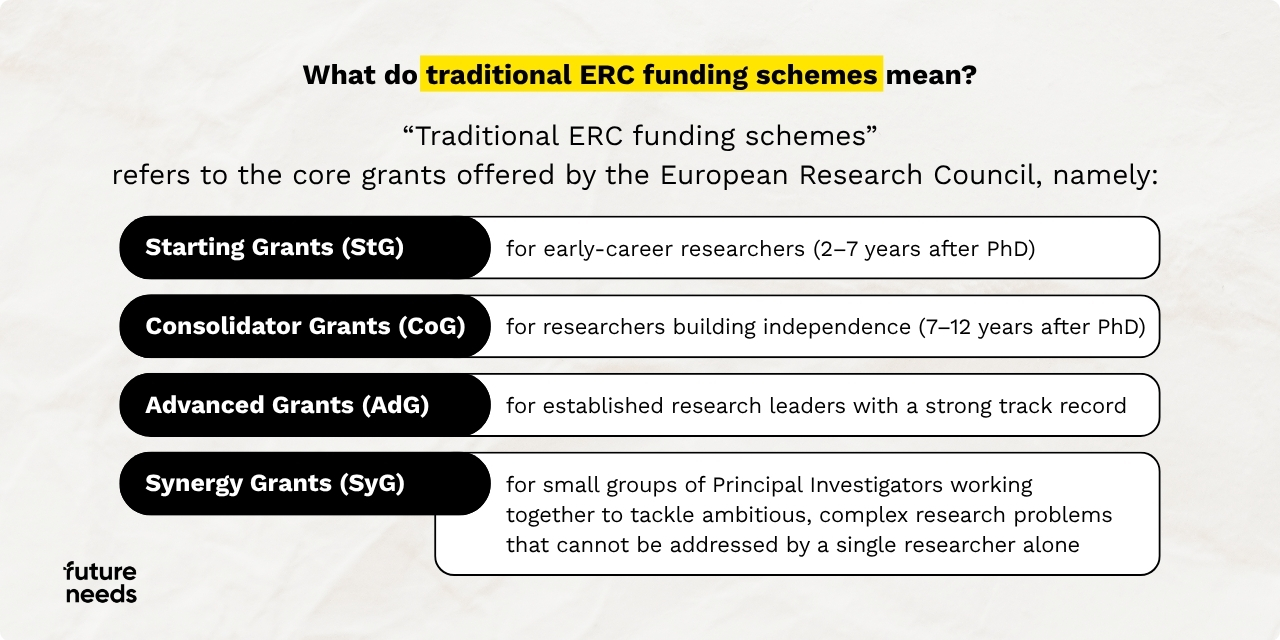
What do traditional ERC funding schemes mean?
“Traditional ERC funding schemes” refers to the core grants offered by the European Research Council, namely:
- Starting Grants (StG) – for early-career researchers (2–7 years after PhD)
- Consolidator Grants (CoG) – for researchers building independence (7–12 years after PhD)
- Advanced Grants (AdG) – for established research leaders with a strong track record
- Synergy Grants (SyG) – for small groups of Principal Investigators working together to tackle ambitious, complex research problems that cannot be addressed by a single researcher alone
While existing ERC grants already fund frontier research, the Plus Grant targets projects that:
- Transform entire fields
- Open completely new research directions
- Address major scientific challenges at an unprecedented scale
In short, these are not just excellent projects; they are field-defining ambitions that cannot be realised under standard ERC funding. For instance, while a traditional ERC grant might support a breakthrough in quantum computing components, an ERC Plus project could aim to build a radically new computing architecture that reshapes the entire field.
So, the ERC Plus Grant is for bold visions. And unsurprisingly, it is also extremely selective and a highly competitive opportunity; in fact, it is one of the most competitive research funding schemes in the world, requiring applicants to carefully assess whether their project truly matches the level of ambition expected.
There are only around 30 grants awarded per year, compared to around 1,000 Starting, Consolidator, and Advanced Grants combined.
Who Can Apply? It’s not just about your idea – it’s about showing you can deliver it
Researchers of any nationality, based anywhere in the world, and at any career stage are eligible to apply, provided that their research is carried out at a host institution located in an EU Member State or an associated country.
Even for early-stage career candidates, it is a must to demonstrate an outstanding track record of scientific achievement and clear intellectual leadership in their field. However, the intellectual leadership will be evaluated in accordance with their career stage. The ERC Plus Grant is not just about having a strong idea; it is about showing that you are the person capable of driving a truly transformative research vision.
In practice, this could include a wide range of profiles, for example:
- An early-career scientist who has already made breakthrough contributions in their field
- A mid-career researcher building a strong international reputation
- An established research leader with a track record of major discoveries
- Or even a researcher working in industry or an SME, provided they apply as an individual Principal Investigator and partner with an eligible host institution
To better understand the level of ambition expected, consider the earlier example of a project aiming to develop a radically new computing architecture that could reshape the field of quantum computing. A vision of this scale would typically require a Principal Investigator with not only deep expertise, but also the ability to operate across disciplines. This could be, for instance:
- quantum physicist pushing the boundaries of how quantum systems are fundamentally designed
- computer scientist or AI expert exploring new computational paradigms
- interdisciplinary research leader capable of bridging physics, engineering, and advanced computing.
The ERC Plus Grant is not just about having a strong idea; it is about demonstrating that you are uniquely positioned to deliver it.
Lastly, what underlines the exclusivity of this scheme is that researchers can receive only one ERC Plus Grant in their lifetime, so this should be carefully considered when applying.
How do you know your project is eligible?
Quick facts at a glance:
- No predefined topics or priorities
- Applications are welcome from any field of research
- Proposals must clearly demonstrate how they go beyond standard ERC projects
- They must have a scale, ambition, or vision not achievable through existing grants
- The research must be hosted by an institution in an EU Member State or an Associated Country
- The Principal Investigator (PI) must dedicate at least 30% of their time to the project and spend at least 50% of their time in Europe
So from these facts, we can see that at its core, the ERC Plus Grant remains fully bottom-up, just like the traditional ERC schemes. There are no predefined themes, no priority areas, and no strategic boxes to tick. Whether your work is in physics, social sciences, life sciences, or engineering, it is eligible.
To come back to the earlier example in quantum computing: imagine a project aiming to develop a radically new computing architecture. This would go far beyond improving existing quantum components or optimising current algorithms. Instead, it could involve rethinking how quantum systems are fundamentally designed and integrated, combining advances in physics, materials science, computer engineering, and artificial intelligence into a completely new computational paradigm.
This is not just a larger project; it represents a fundamentally different level of ambition:
- Interdisciplinary collaboration at scale
- New technological infrastructures
- And a long-term vision that extends well beyond typical project boundaries
That is exactly the kind of leap the ERC Plus Grant is designed to fund.
Now let’s take a look at the funding scheme.
Funding, Duration, the Evaluation, and the Application Process
The ERC Plus Grant offers substantial support to the projects. Compared to the traditional ones, the projects funded by the ERC Plus Grant received:
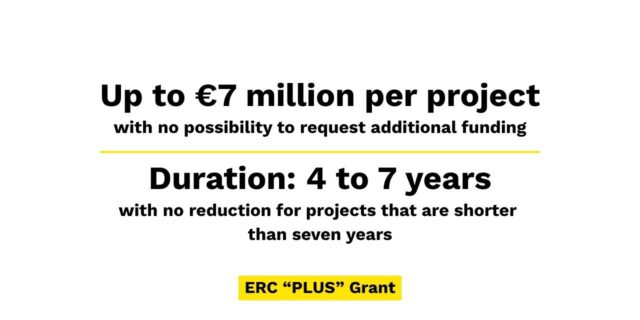
- Up to €7 million per project (with no possibility to request additional funding)
- Duration: 4 to 7 years (with no reduction for projects that are shorter than seven years)
The evaluation process remains rooted in excellence as the sole criterion, but expectations are significantly higher. Key differences include:
- Greater emphasis on past achievements and leadership
- Stronger focus on transformative potential
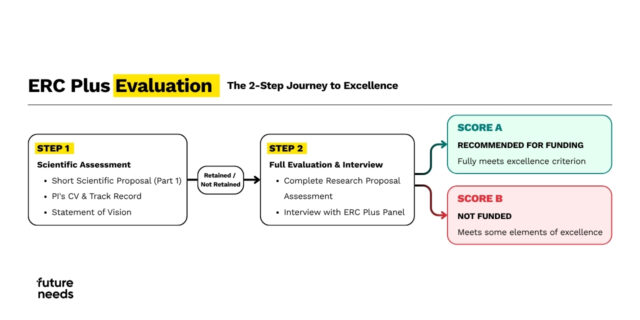
Explained on the official ERC website, the process involves 2 steps:
- Step 1: Assessment of: Short proposal, CV and track record, Statement of Vision
- Step 2: Full proposal evaluation, Interview with the evaluation panel
At Step 1, the short form of the scientific proposal (Part 1), the Principal Investigator’s CV and track record, and the Statement of Vision are assessed.
Based on the outcome of the assessment at Step 1, only proposals of the highest quality will be retained for Step 2 of the evaluation through a retained/not retained decision.
At Step 2, the complete research proposal is assessed, and the Principal Investigator presents their proposal at an interview to the ERC Plus Step 2 evaluation panel.
At the end of Step 2 of the evaluation, the proposal receives one of the following scores: A: (proposal fully meets the excellence criterion and is recommended for funding should sufficient funds be available), or B (proposal meets some but not all elements of the excellence criterion and will not be funded).
Need support with your ERC grant application?
The path to ERC funding is rarely linear. As highlighted in personal testimonials from researchers, success often comes after multiple attempts, rejections, and refinements. Even strong proposals may fail due to:
- Lack of clarity in ambition
- Misalignment with panel expectations
- Insufficient demonstration of “progress beyond state-of-the-art” and impact
With years of experience in proposal writing, including ERC Grants, Future Needs can support you in developing a highly competitive proposal by offering an external perspective, expertise in evaluating potential impact, and guidance to ensure alignment with the funding scheme’s requirements and expectations. For more information, contact our Head of Proposal Writing at chariton@futureneeds.eu.
