
The aviation sector is entering a defining moment. Demand is rising, capacity is stretched, and the environmental and social pressures are impossible to ignore. Climate impact, air quality concerns, noise, and public-health implications all demand faster, smarter action.
At the same time, the emergence of innovative air mobility (ΙΑΜ) is creating a whole new world of possibilities through technological advances. Yet even the best technologies cannot take off without the regulatory evidence and policy alignment to support them. The industry urgently needs validated, scalable solutions.
Bridging innovation and real-world needs through RefMap
Within the RefMap project, the primary goal was to develop tools that respond to the operational and societal needs of both the aviation and IAM sectors. These tools support advanced flight planning while taking into account environmental impacts, safety, and social acceptance. Importantly, the project’s ambition went beyond tool development alone.
A key objective was to ensure that these capabilities were grounded in real user needs. Building on this foundation, the project explored how such tools could influence the business and operational landscape of the aviation ecosystem, as well as enable the creation of new business products and prototypes.
From technology to business value
Our work aimed to provide insights into how RefMap and other available tools could affect the business models of key stakeholders.
The analysis examined:
- how these tools are likely to be adopted in practice
- what conditions enable or hinder their uptake
- how they can create measurable business value
Within the research team, Anna Palaiologk, CEO and founder of Future Needs, played a central role in guiding the ideation process and shaping the study.
Reflecting on her experience, she noted:
“Being involved in such an impactful project, with the potential to reshape the aviation and drone industry through advanced tools and simulations, has been incredibly rewarding. I was especially excited to contribute to positioning these tools in the market and navigating the business and regulatory landscape to achieve the right product fit. What truly surprised me, however, was the large number of participants engaged in the process and their strong interest in learning more about what RefMap can offer and how it can support the transition toward more sustainable aviation business models.”
Aligning business models with policy and sustainability goals
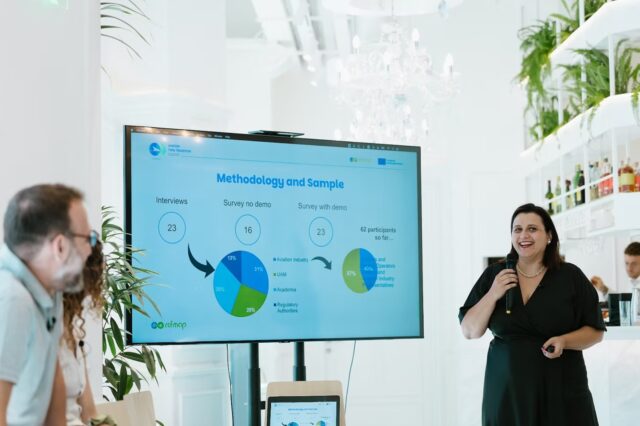
Future Needs assessed the impact of solutions enabling sustainable aviation on existing ecosystem business models.Why is this important? The tools developed within RefMap address current challenges related to cost reduction and upcoming regulatory requirements, including SAF mandates, revisions to the EU ETS, and non-CO₂ regulations. At present, the main driver of change lies not in the market but in policy. Accordingly, our objective was to support a more sustainable and forward-looking aviation industry by addressing both current and future stakeholder needs and by providing clear guidance on how aviation business models can be reshaped. We explored priorities, pain points and dynamics of operators and regulators, urban planners, environmental agencies, and emerging mobility players. Ultimately, we wanted to map how the market and policy can advance together.
What aviation stakeholders really need: from data to actionable insights
We worked closely with stakeholders throughout the project. Feedback from 83 stakeholders showed a clear preference for tools that offer practical recommendations, rather than just raw data or complex analytics.
For example:
In the IAM (drone) sector:
- Which areas should be avoided under strong wind conditions?
- What noise impact will operations have on communities?
In commercial aviation:
- How can pollution around airports be reduced?
- Which parts of a flight path have the highest climate impact?
These are practical, real-world questions. As a result, these features were integrated into the platform’s minimum viable product (MVP), ensuring usability and direct operational value.
Discover more of the insights shared during the RefMap clustering event 2025, through this video presenting what potential customers and users have said about our tools – what their requirements are and which functionalities they found most useful.
Curious to learn more about the RefMap Minimum Viable Product? Check out our publication here and explore our latest findings, which will be presented at Transport Research Arena (TRA) 2026.
From insights to adoption: what the market tells us
With user priorities clearly defined, we shifted our focus to how the RefMap Platform’s features could translate into real business value. We spoke with 15 representatives from airlines, consultancies, air navigation service providers, aviation authorities, and drone service providers to understand whether and how these solutions could be adopted in practice to support operations and improve decision-making.
Our discussions focused on key questions such as:
- Would such a solution provide added value to your organization?
- Is it something you are already considering, might consider in the future, or not at all?
- What adoption costs would you be willing to accept? And what kinds of revenues or benefits could it generate?
- Would these be sufficient to justify adoption?
Based on the responses, solutions were categorized into:
- critical (short-term relevance)
- emerging (mid-term potential)
- long-term opportunities
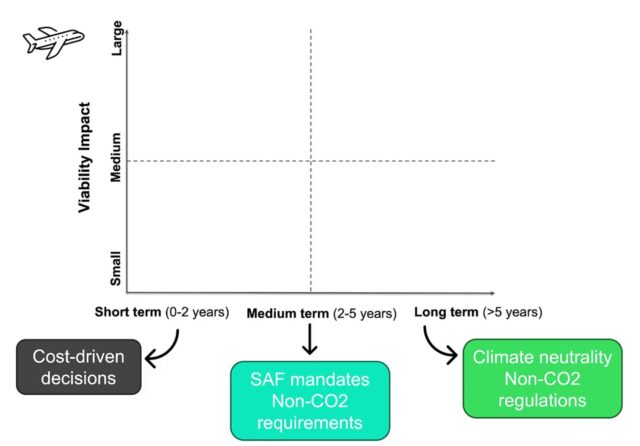
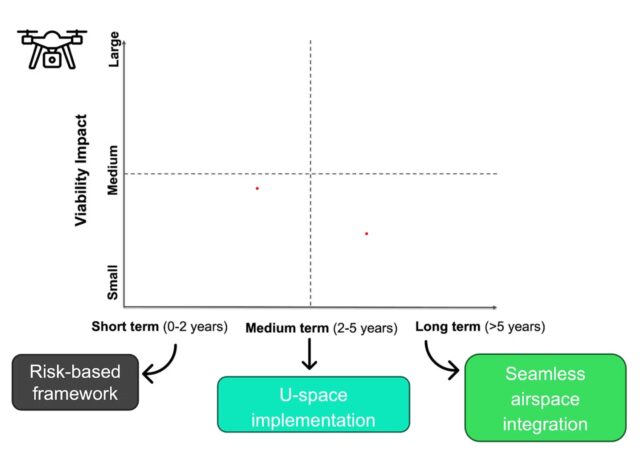
To make sense of these insights, we grouped the identified solutions into a matrix that reflects their level of importance over time. This timeline was aligned with the evolving regulatory landscape of both traditional aviation and IAM.
A changing landscape: from cost efficiency to environmental accountability
In conventional aviation, today’s priorities are largely driven by cost reduction, with a gradual shift toward frameworks that account for non-CO₂ impacts and greener operational pathways.
In the IAM sector, the evolution of drone regulations signals a transition from a fragmented “pioneer” phase toward a more structured aviation ecosystem. From technical requirements for legal operations to automated traffic management through U-space, the trajectory points toward the full integration of unmanned aircraft into shared airspace alongside manned aviation.
This work allowed us to explore the potential of sustainable digital aviation platforms, such as RefMap, to enhance both the competitiveness and environmental performance of the European and global aviation sectors. Insights from a parallel market analysis showed that most existing tools are still at a similar, early (pre-commercial) level of maturity. At the same time, the lack of strict legislative frameworks means that these tools are particularly well suited to support policymakers in the first instance. By providing solid evidence and clear insights, they can help shape future policies and lower the cost burden associated with adopting environmentally responsible practices.
Preparing for the next regulatory shift
In this context, the milestone year of 2027 plays a key role, as it marks a potential point for assessing whether stricter regulations on non-CO₂ emissions should be introduced. Data generated by such tools can support policymakers in making informed decisions, while also giving aviation operators the time and guidance needed to prepare for upcoming regulatory changes. From a business perspective, there was a strong preference for software-as-a-service (SaaS) solutions, as these allow organizations to avoid high upfront investment costs and adopt new tools more flexibly.


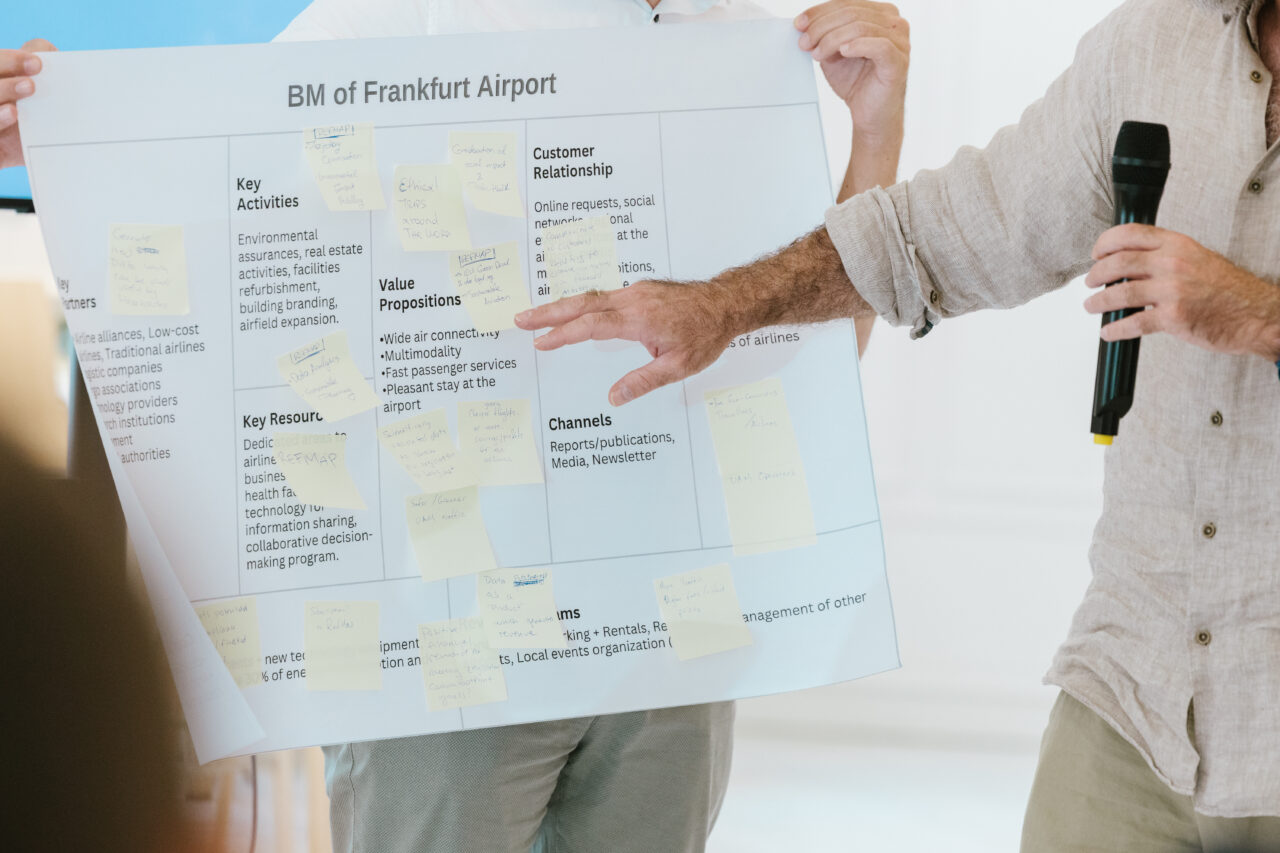
A hands-on workshop on Validating New Aviation Business Models, led by Future Needs at the Aviation Twin Transition Clustering Event in Athens, 2025
From Innovation to Readiness
Technology alone, no matter how promising, can only make a real difference if it fits the realities of the aviation ecosystem. Through our discussions with experts from across the sector, we were able to identify which challenges can already be addressed today, which gaps still remain, and how emerging tools can help stakeholders prepare for future needs while remaining compliant and efficient. The strong engagement from participants, reflected in the high response rate and the frequent need for follow-up discussions, also highlighted their eagerness to better understand what lies ahead and how they can anticipate and manage upcoming challenges.
This is how we move the conversation from innovation for today to readiness for tomorrow, ensuring that new aviation technologies are not just visionary, but viable, scalable, and supported by policy from the start.
About the author

Sofia Iosifidou is an Innovation Researcher at Future Needs, holding an Engineering Doctorate in Process & Product Design. She focuses on R&D and techno-economic analysis, contributing to sustainable and environmentally driven projects, with a particular interest in energy transition and low-carbon solutions. Email Sofia at sofia@futureneeds.eu.
