

The European Commission has released a revised Standard Application Form (Version 5.0) for Horizon Europe proposals as part of its ongoing simplification agenda. The updated templates apply to Research and Innovation Actions (RIA), Innovation Actions (IA), and Coordination and Support Actions (CSA) under the 2026–2027 Work Programme.
This article provides a short, authoritative reference for coordinators and proposal teams on what has changed, why it matters, and where to find the official documents.
Which proposals are affected?
The revised Standard Application Form v5.0 applies to:
- Research and Innovation Actions (RIA)
- Innovation Actions (IA)
- Coordination and Support Actions (CSA)
Important: It applies only to call topics published under the Horizon Europe 2026–2027 Work Programme.
Practical reminder: Always use the template linked directly to your specific topic in the Funding & Tenders Portal. Do not reuse earlier versions.
What has changed: The key updates at a glance
The revised templates introduce four major changes:
✓ Lighter Impact section (Section 2.1)
✓ Simplified Work Plan and Resources section (Section 3.1)
✓ Fewer narrative cost tables
✓ Reduced page limits across all action types
These changes aim to reduce administrative load and allow applicants to focus on concept quality, credible implementation, and more flexible impact logic.
Section 2.1 simplified: Project’s pathways towards impact
In Section 2.1, several guidance elements have been removed. Most importantly, applicants are no longer asked to describe the “scale and significance” of their expected contributions. According to the Commission, this requirement proved difficult to quantify in practice and added complexity without improving proposal quality.
What this means in practice
The focus remains on how project results lead to outcomes and longer-term impacts. You should clearly articulate:
- Who benefits from your project
- How they benefit
- Why your approach creates impact
Quantitative estimations of scale or magnitude are no longer explicitly required. This change is aligned with updated evaluator guidance for the 2026–2027 calls.
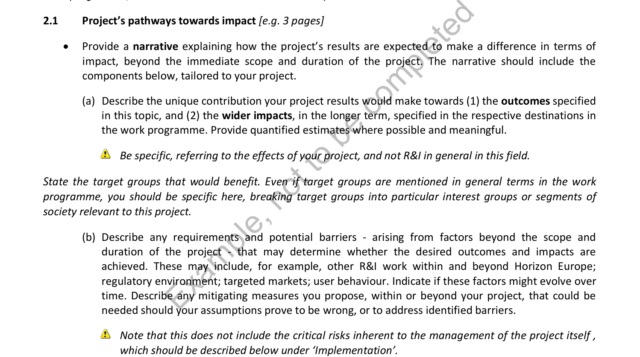
Revised Section 2.1 “Project’s pathways towards impact” in the Standard Application Form v5.0, showing streamlined guidance and removal of scale and significance prompts.
Source: European Commission – Standard Application Form (RIA & IA), Version 5.0
Section 3.1 simplified: Work plan and resources
In Section 3.1, the following tables have been removed:
- Other cost categories
- In-kind contributions
The purchase costs table has also been simplified and now focuses only on major equipment.
Commission rationale
For proposal evaluation, the Commission notes that:
- Evaluators mainly need high-level information on work planning and major resources
- Additional financial detail can be placed as a comment in the budget table (if the funding model is lump sum) or requested after evaluation, for proposals retained for funding
Practical implications for applicants
✓ Less narrative detail on minor cost items
✓ More emphasis on a coherent work plan, clear task structure, and realistic resource allocation
✓ Budget credibility remains important, but with fewer narrative justifications in Part B
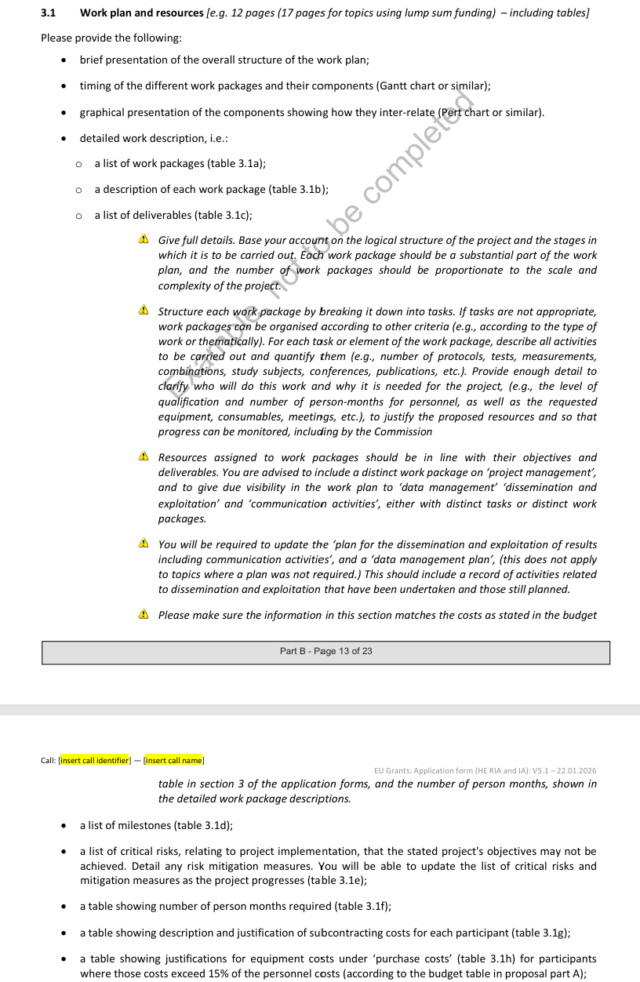
Revised Section 3.1 “Work plan and resources” in Version 5.0, showing the reduced number of cost tables and simplified purchase costs section.
Source: European Commission – Standard Application Form (RIA & IA), Version 5.0
New page limits for proposals
The revised templates introduce shorter, system-enforced page limits.
Warning: Any content exceeding these limits will not be visible to evaluators.
Page limits for 2026–2027 calls
| Action type | Standard topics | Lump sum topics |
| RIA and IA | 40 pages | 45 pages |
| CSA | 25 pages | 28 pages |
When do these changes apply?
- The revised Standard Application Form v5.0 applies to Horizon Europe 2026–2027 call topics only
- It does not apply retroactively to earlier Work Programmes
- The authoritative version is always the one linked in the Funding & Tenders Portal
What this means for proposal teams
Overall, the revised templates reflect a clear shift toward:
- Simplified implementation plan
- Greater flexibility in explaining impact
- Tighter space to demonstrate excellence, impact logic, and implementation quality
Proposal teams preparing for the 2026–2027 calls should adjust early to the revised structure and page limits.
Official templates and EU sources
Revised Standard Application Form (Version 5.0)
- RIA & IA – Part B template: Download from European Commission
- CSA – Part B template:Download from European Commission
Final checklist for applicants
Before you start drafting:
- Use the template linked to your specific call topic
- Do not rely on templates from previous Work Programmes
- Check page limits before drafting begins, not at submission stage
- Review the simplified Section 2.1 and Section 3.1 requirements
- Adjust your work plan to focus on major resources only
How Future Needs can help
Future Needs supports Horizon Europe consortia with:
- Full-package proposal writing under revised templates and page limits
- Impact pathway design aligned with evaluator expectations
- Dissemination, communication, and exploitation (DCE) strategies
Preparing a proposal for the 2026–2027 calls? If you need support on impact, stakeholder engagement, or full proposal development, we’re here to help your team succeed. Contact our team for expert guidance.

Anna Palaiologk, the founder of Future Needs, is a Research & Innovation Consultant with 18 years of experience in proposal writing and project management. She has worked as a project Coordinator and Work Package leader in 30+ EU projects and has authored 50+ successful proposals. Her research background is in economics, business development and policy-making. Email Anna at anna@futureneeds.eu.

Chariton Palaiologk, the Head of the EU Project Management Team, is currently leading the project management of 10+ EU-funded projects. He has a background in data analysis and resource optimisation, having worked at the Greek Foundation for Research and Technology. Email Chariton at chariton@futureneeds.eu.

Thanos Arvanitidis is a Researcher & Innovation Project Manager, with a background in physics and biomedical engineering. He manages EU-funded research projects from initial conception through to implementation, working across key Horizon Europe clusters, including Cluster 1: Health; Cluster 4: Digital, Industry & Space. His expertise spans AI, healthcare, cybersecurity, and digital education. Email Thanos at thanos@futureneeds.eu.
