
Key findings at a glance
- In 2019 alone, EU Member States granted citizenship to 729,000 people, underlining how central immigrant integration has become to Europe’s future.
- Housing hits immigrants hardest: the housing cost overburden rate for non-EU citizens was 25%, versus 19% for other EU citizens and just 9% for nationals. Only 23.8% of non-EU citizens owned their home, against 70.7% of nationals.
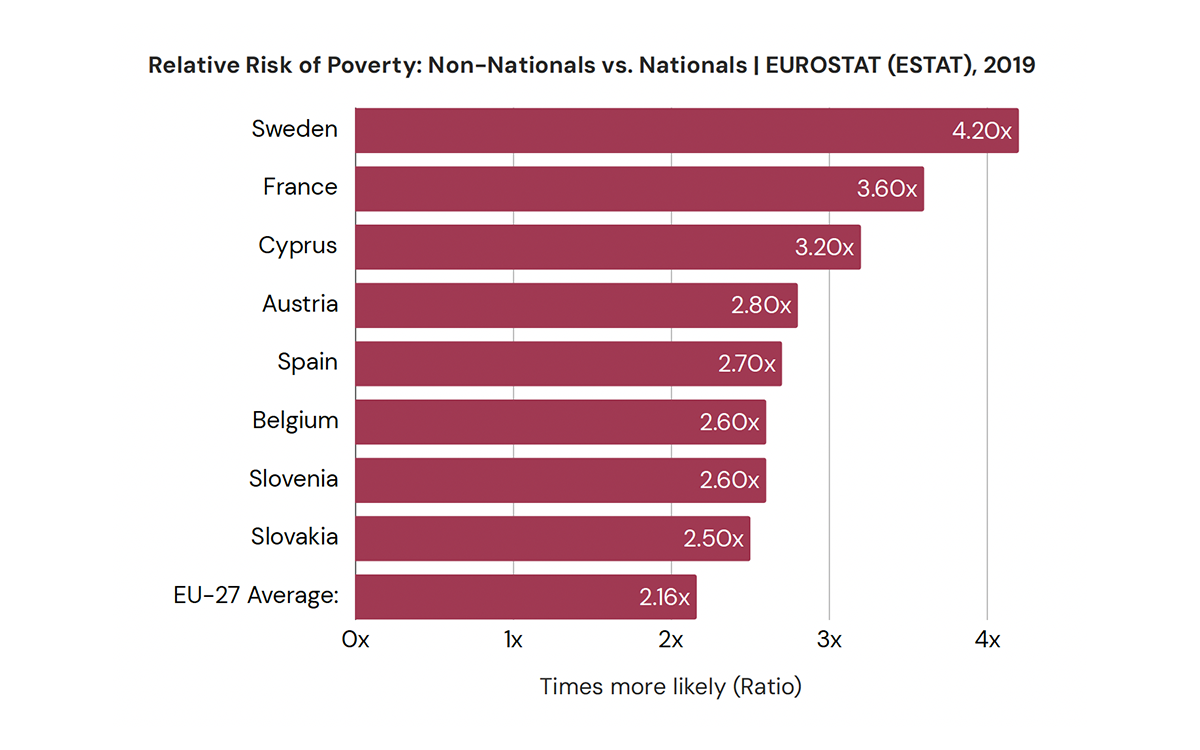
- Non-nationals are more than twice as likely to be at risk of poverty (31.6% vs 14.6%), rising to over 4x in some countries.
- Gender compounds the gap: two-thirds of the world’s illiterate are women, and women are 1.6x more likely than men to cite digital skills as a barrier to internet use.
- Adoption depends on usability: tools must be simple, accessible and low on third-party dependencies to reach users with limited devices, literacy or language.
- Built on a PACT analysis (People, Activities, Contexts, Technologies) and Future Needs’ work in the EU-funded PLOUTOS project.
Methodology
What is PACT Analysis, and how is it used?
At its core, PACT Analysis is a human-centred design (HCD) framework used to map the complex interactions between users and digital solutions. Originally proposed by David Benyon, it isn’t just a checklist; it is a structured way to break an interactive system into manageable parts so the final product is both effective and user-friendly. By analysing four critical dimensions, People, Activities, Contexts and Technologies, designers can move beyond assumptions to identify real-world requirements.
- People: the actual users, accounting for physical differences like age or ability, psychological factors such as motivation and cognition, and social or cultural backgrounds.
- Activities: the specific tasks being performed, evaluating their purpose, complexity, frequency, and whether they require collaboration with others.
- Contexts: the environment where the interaction takes place, from physical settings (noise, light) to social norms (privacy) and organisational hierarchies.
- Technologies: the hardware and software used, specifically how the system handles data and which communication protocols best suit the user.
In practice, PACT is used in the early stages of a project to define the target audience, map out necessary tasks, and select the technology that best fits the identified environment. It is an iterative process, meant to be revisited as a project develops to keep the design aligned with user needs.
Why PACT analysis matters
The goal of the PACT framework is to prevent the design failures that occur when developers make “obvious” assumptions about their users. It allows teams to:
- Avoid assumptions: by forcing designers to answer difficult questions, such as “what is the organisational context?”, it prevents tools that look good in a lab but fail in the real world.
- Solve problems comprehensively: it serves a dual purpose, both for analysis (identifying why current systems fail) and for design (envisioning how future solutions should function).
- Keep people first: it shifts the focus from “what can this technology do?” to “what does this person need to achieve in this specific environment?”
In design terms, PACT ensures the final product is not just a piece of software, but a solution tailored to the specific physical, social and psychological realities of the people using it.
Foreword
A message from our founder
Ensuring that third-country nationals can fully participate in the financial life of their new homes is more than a social goal; it is a vital step toward long-term economic resilience for all of Europe. As we move from identifying deep-seated systemic hurdles to implementing practical frameworks, we have reached a defining moment: shifting from simply acknowledging these barriers to actively dismantling them.
At Future Needs, we view the current state of immigrant integration as a complex challenge that demands innovative thinking. While the European Union is strategically working to harness the talents of those arriving from abroad, the path remains obstructed by significant housing disparities, persistent gender gaps, and unequal access to digital tools. Historically, the absence of comprehensive, data-driven strategies has made it difficult to bridge these gaps in a meaningful way.
By utilising our People, Activities, Context and Technologies (PACT) analysis and our extensive work in the PLOUTOS project, we have developed actionable insights to address these challenges. This white paper provides an in-depth look at the specific vulnerabilities immigrant communities face, offering the strategic intelligence needed for policymakers and service providers to create a truly fair and accessible financial landscape.
We are honoured to provide this roadmap to help foster an environment where everyone, regardless of where they began their journey, has the opportunity to achieve financial stability and contribute to our shared future.
Anna Palaiologk, Founder of Future Needs
Introduction
Introduction
In today’s ever-evolving global landscape, the integration of immigrants into their host countries has gained paramount importance. Immigrants constitute a vulnerable social group, yet their successful integration fosters global diversity and contributes significantly to the prosperity of the receiving nation. This is particularly relevant in the European Union, where ageing populations and a need for fresh human capital have led countries to strategically tap into the potential of individuals from beyond EU borders.
“By comprehending the financial challenges, social disparities, and systemic obstacles faced by immigrants, societies can strive to build a more inclusive, equitable, and harmonious environment for all residents, irrespective of their country of origin.”
The urgency of this issue is underscored by the surge in citizenship grants: in 2019 alone, EU Member States extended citizenship to 729,000 individuals. However, the journey is fraught with challenges. Instances of social exclusion, material deprivation, and alarming unemployment rates persist, highlighting a glaring inequality in the accessibility of public and private services. To transform this journey into one of dignity and opportunity, we must look deeper into the systemic obstacles, from financial acumen to cultural assimilation, that immigrants face daily.
01 · Financial vulnerabilities
Understanding the vulnerabilities of immigrants in managing finances and accessing services

Immigrants, individuals who have migrated from their country of origin to a foreign land, constitute a vulnerable social group. Their successful integration not only contributes to the prosperity of the receiving nation but also fosters global diversity and collaboration. However, this process is far from simple. As immigrants seek to establish their lives in a new country, their ability to effectively manage finances, comprehend intricate financial products and services, and navigate complex legal frameworks becomes pivotal.
The recent surge in citizenship grants underscores the urgency. In 2019 alone, EU Member States extended citizenship to a staggering 729,000 individuals residing on EU soil, a notable increase on the previous year. Migrants play a pivotal role in driving the growth and development of the EU-27 economies; with ageing populations and the need for fresh human capital, European countries have strategically tapped into the talents of individuals from beyond the EU borders.
The diversity within this group is profound, encompassing individuals with a wide array of backgrounds and educational levels. This heterogeneity poses a significant challenge in tailoring integration efforts to the specific professional requirements of such a diverse population. Despite collaborative initiatives at both multinational and local levels, a sombre reality persists: instances of social exclusion, material deprivation, inadequate housing conditions, and alarming unemployment rates underscore a glaring inequality in the treatment of, and access to, public and private services across European nations.
02 · Housing
Overcoming housing inequalities for immigrants’ economic power and social stability
Housing is another facet of inequality. In 2019, the highest housing cost overburden rate in the EU-27 was recorded for non-EU citizens (25%), while lower rates were observed for citizens from other EU countries (19%) and national citizens (9%). This threatens the power of families and individuals to rise in economic strength and social stability. Often faced with lower salaries and higher rents, immigrants have to invest a greater share of their income into housing, leaving little room for self-improvement and education.
“Immigrants face unique challenges in navigating housing costs and overcrowded conditions, affecting their economic power and social stability.”
Immigrants confront the greatest overburden among EU-27 residents. A 2019 Eurostat article reveals that 7 out of 10 (70.7%) of national citizens in the EU-27 lived in their own dwellings, as opposed to non-EU citizens, whose share was below a quarter of the population (23.8%). They are also the group with the highest ratio of overcrowded housing conditions, and multigenerational housing is more common among non-EU citizens. Providing and caring for others while trying to achieve financial stability can be overwhelming, so time management and easy access to platforms, goods and services can heavily influence the success of a project or public policy.
Over one in seven (14.6%) EU-27 nationals were at risk of poverty, while non-national residents’ risk of poverty is more than double that, at 31.6%.
EUROSTAT (ESTAT), 2019
Relative risk of poverty: non-nationals vs nationals
How many times more likely non-nationals are to be at risk of poverty than nationals (EUROSTAT, 2019).
Being able to facilitate access to training courses and certificates empowers these individuals to better organise and attend lessons, and to manage their time and effort per module in a way that fits their daily needs. Employability and educational level play a pivotal role in their ability to navigate foreign cultures and support their own communities and families. Education level also heavily influences how people interact with online and mobile applications, so a tool must present information concisely, with easy-to-read text and approachable iconography.
03 · Gender
Gender inequality’s impact on education, employability and financial prospects

Gender inequality plays a significant role in the education levels of third-country nationals. In countries such as Belgium, Italy and Sweden, a higher percentage of males who obtained third and fourth-level educational certification are currently employed, in contrast to their female counterparts at the same educational levels. The exception is Cyprus, where the employment rate reaches 63% of female third-country nationals with third and fourth-level education, while employed males at the same levels amount to 40.8%.
“Gender inequality plays a significant role in the education and employability of third-country nationals, further impacting their integration and financial prospects.”
Due to salary disparities, overloaded domestic work and patriarchal family standards, women often face greater workloads than men. This heavily influences women’s power to invest time and effort into themselves, leading to a sense of unfulfillment, discouragement from pursuing career and vocational goals, and a lack of independence. The intersectional quality of this context shows how gender, class and race interact to affect the successful integration of non-national populations.
Two-thirds of the world’s illiterate population are women. In South Asia, women are 38% less likely than men to own a mobile phone, and women are 1.6 times more likely than men to report digital skills as a factor limiting their use of the internet. For low-literate and low-income users, gender matters.
UNESCO Guidelines for Digital Inclusion for Low-skilled and Low-literate People
From the number of citizenship applications to the activity rate by gender, these factors set major hindrances to women seeking financial stability and social security. From a doubled workload to cultural upbringing, women face fewer job opportunities, lower income and a greater chance of poverty. The rate of labour-market slack in EU-27 countries also reveals an accessibility problem: many countries host overqualified migrants who possess the necessary skills, yet many non-European citizens take on part-time roles because they cannot provide relevant certification, intensifying overall underemployment.
04 · Technology access
Bridging the gap: access to technology and digital skills
Resting on this data, it is also clear that immigrants’ access to devices such as smartphones, desktop computers, tablets or laptops can be limited or non-existent in some cases. It is therefore of extreme importance that the tools they use are easily accessible, which means decreasing reliance on third-party platforms and tools as much as possible to avoid device and system incompatibilities.
“Access to technology and digital skills are essential for immigrants to bridge communication gaps and empower themselves in the host country.”
05 · Integration
Empowering integration and skill development: language barriers and digital literacy
Integrating immigrants is a particularly hard task when it comes to language barriers. Trainers and teachers may encounter a multiplicity of ethnic groups, dialects, languages and cultural backgrounds, so different approaches must be taken depending on the social context of the applicants. To empower immigrants in acquiring essential professional up-skilling, we leverage their familiarity with local iconography, language standards and social context, which is particularly beneficial for those already residing in the country.
Streamlining the reading elements of interfaces is necessary to assist the 20.4% of immigrants in Cyprus and 15.9% in Belgium who have only a basic understanding of their host country’s language, as well as the 21.9% of Greeks, 20.9% of Cypriots and 21% of Swedish whom ESTAT reports to have moderate knowledge of the host country. Contrary to common assumptions, immigrants’ internet usage scores high across all participating countries: Croatia has the lowest share, at 78% of individuals who had used the internet at least once in the last three months, which is still a strong rate.
Top non-national resident groups by country (2020)
Non-nationals residing within the above EU countries, according to EUROSTAT, 2020.

Efficiently managing user access and scheduling profoundly influences platform usage and participation in synchronous meetings and lessons, and it proves a valuable asset in a learning methodology that caters to diverse needs. Often the greatest teacher is someone nearby who is willing to help. Human connections play a crucial role in acquiring shared knowledge, and this holds true for immigrants and their family and friends. By integrating the community around them, we empower multiple individuals simultaneously.
Low-literate users don’t use technology alone. Low-income people often live in close-knit communities. Social norms and hierarchies influence who has access to technology, how information flows between community members, and who is trusted. The ecosystem around the user has a profound influence on digital usage.
UNESCO Guidelines for Digital Inclusion for Low-skilled and Low-literate People
Reasons for non-internet use among non-nationals (2012)
Why non-nationals who had not used the internet in the last three months said they do not use it (ESTAT, 2012).

A 2012 ESTAT dataset suggests the main reason non-nationals do not use the internet from home or work is that it is “not necessary” for them (53% in Belgium, 74% in Greece, 84% in Croatia, 82% in Cyprus and 60% in Sweden). The second most common reason is that they “don’t know how to use mobile internet or its use is too complicated” (8% in Belgium, 28% in Greece, 8% in Croatia, 22% in Cyprus and 33% in Sweden).
06 · Financial education
Streamlining financial education and certification for financial stability
Many immigrant families face challenges in using basic financial services, primarily due to past experiences with financial institutions in their home countries. Trust issues arise when consumers are unaware of potential fees or find bank charges poorly explained. Low-income immigrant households may miss out on the benefits of savings accounts and other products if they don’t fully understand the associated fees, resulting in financial exclusion.
“By streamlining financial education and certification, we can empower immigrants to overcome barriers, achieve financial stability, and contribute to their host country’s development.”
Another significant obstacle is the absence or negative status of credit history in the host country. Without access to consumer credit information, banks and credit rating agencies cannot build a favourable credit record, leading to exclusion. Documentation and identification requirements pose further difficulties, as there is often confusion about which documents are needed to open accounts. Some immigrants fear investigation or the sharing of information with immigration authorities, leading them to keep their savings outside the banking system. Limited lending options present additional challenges for foreign small-business owners, who often face exclusion from sources other than credit cards and personal loans.
The expectation of a permanent return to their home countries may dissuade some immigrants from learning about the host country’s financial system, increasing the risks associated with long-term decisions such as investing in property or saving for retirement. Language challenges exacerbate the situation, as financial information and documents may only be available in the host country’s language, and inadequate translation can cause confusion.
“Multilingual and culturally sensitive approaches to integration can empower immigrants to navigate financial systems, fostering inclusivity and equality.”
Immigrants living in nationally separated or concentrated neighbourhoods may be influenced by their neighbours’ unfamiliarity with the country’s financial systems, affecting their participation in the official financial system. They are also more susceptible to potential fraud and deceptive practices during their early years in the host country, adding to the risks they face.
Conclusion
An inclusive financial system is an opportunity, not just an obligation
Empowering immigrants for financial inclusion is a pressing challenge and a remarkable opportunity in today’s global landscape. Integration is hindered by language barriers, digital literacy gaps, housing inequalities and gender disparities. Addressing these issues is crucial for building an inclusive and harmonious society.
“Addressing financial challenges faced by immigrants is not just a matter of economic significance; it is an opportunity to embrace diversity and harness the potential of a global talent pool.”
Solving these challenges requires technology access, digital skills and comprehensive financial education. By overcoming language barriers, streamlining financial education and creating user-friendly platforms, we can empower immigrants to navigate complex systems, enhance their economic prospects and contribute to host countries’ growth. Through inclusivity, we foster collaboration, innovation and shared prosperity.